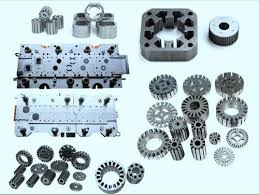
Tooling refers to the design and production of tools used to manufacture parts and components. These tools include dies, jigs, fixtures, and molds—each designed for specific processes such as cutting, bending, punching, or shaping metal and other materials. 🖥️ Design & Development At SKE, we use advanced software like AutoCAD, SolidWorks, and CAM tools to design and simulate these tools. This ensures: High dimensional accuracy Reduced trial-and-error Faster time to production
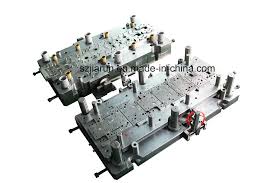
1. Progressive Tool
Definition:
A progressive tool (or progressive die) performs multiple operations in a single stroke as the strip of material moves through the tool.
Features:
- Performs cutting, punching, bending, and forming in stages.
- Material feeds continuously through the die.
- Each stroke of the press advances the part closer to completion.
Benefits:
- High-speed production.
- Excellent for high-volume parts.
- Reduced manual handling.
2 Compound Tool
Definition:
Definition: A tool that performs two or more operations (like blanking and piercing) in a single stroke at the same station.
Features:
- All operations are completed simultaneously.
- Suited for simpler parts with fewer features.
Benefits:
- High accuracy in critical tolerances.
- Shorter production cycles.
3. Combination Tool
Definition: A tool that combines cutting and non-cutting operations, such as drawing and piercing.
Features:
- Suitable for parts requiring both forming and piercing in the same stroke.
Benefits:
- Time-saving.
- Consistent part quality.
4. One Stroke Tool / Single Stroke Tool
Definition: A tool designed to complete the entire operation in one stroke of the press.
Features:
- All shaping, cutting, or forming is done in a single hit.
Benefits:
- Quick setup.
- Suitable for low to medium volume production.
5. Component Tool
Definition: A customized tool made for manufacturing specific components or assemblies.
Features:
- Tailored to client drawings or product requirements.
Benefits:
- High precision.
- Repeatable quality.
6. Blanking Tool
Definition: A tool used to cut the external shape or outline of a component from sheet metal.
Features:
- Produces a flat part.
Benefits:
- Precise outline.